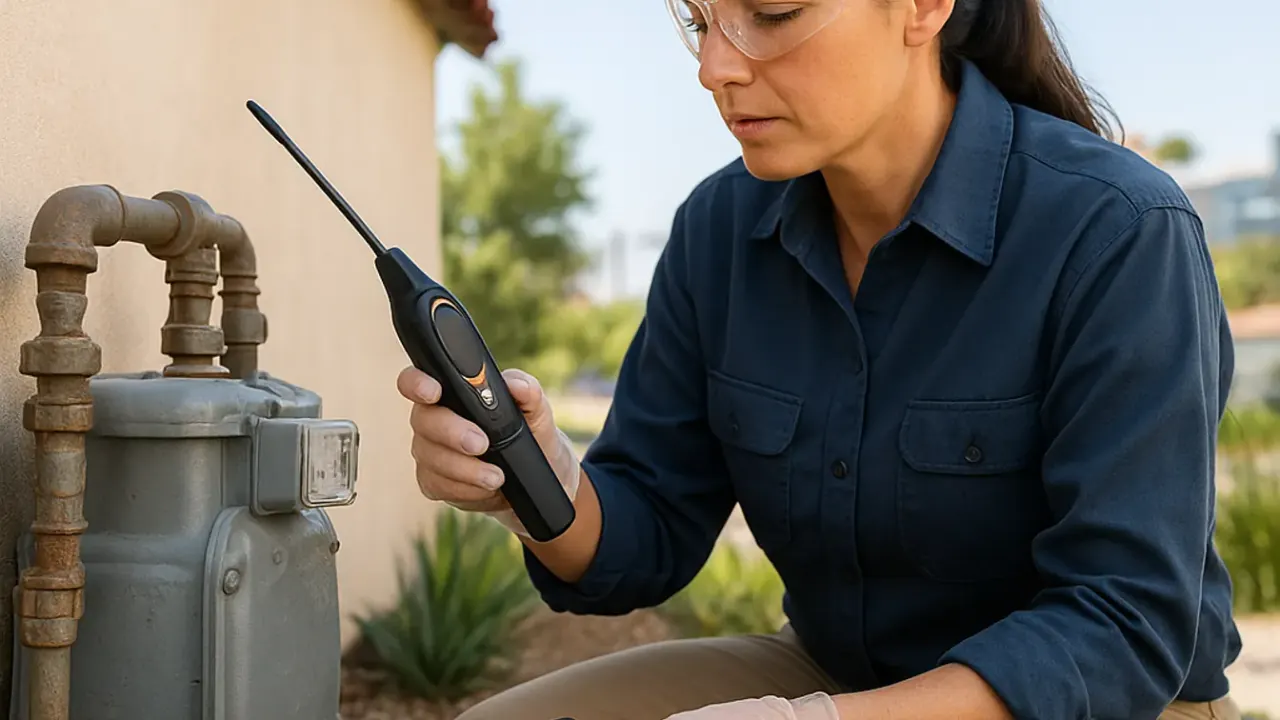
A gas smell near your meter means natural gas is escaping somewhere between the city service line and your home's interior piping, and you should treat it as an active leak until a professional proves otherwise. The odor you're smelling is mercaptan, an additive SoCalGas injects so you can detect gas at concentrations as low as 1 part per million - long before it reaches the 4% to 5% lower explosive limit. If you smell it outside by the meter, shut the gas off at the valve, step away from the structure, and call for help. The rest of this post walks through what that smell actually means, how to shut the gas off safely, and how professional gas leak detection Santa Ana CA pinpoints the source without tearing up your yard.
What a gas smell near your meter actually means
A gas smell near my meter is a leak indicator that falls into one of three categories: a leak at the meter assembly itself, a leak in the underground service line running to the house, or a leak inside the home that's venting outdoors through a foundation penetration. Each one has a different owner, a different fix, and a different urgency level.
Meter assemblies are the most common culprit. The union fittings, the regulator, and the shut-off valve all live in a small metal housing that bakes in the sun and takes on moisture from sprinklers. Rubber diaphragm seals inside the regulator dry out and crack. A fitting that was torqued to spec ten years ago can loosen a quarter turn after enough thermal cycling.
Underground service lines are the second category. In Santa Ana, most residential gas services are yellow polyethylene or older coated steel. Polyethylene is tough, but it's vulnerable to root intrusion and to settling soil. Steel corrodes. A pinhole the size of a pen tip can push enough gas to the surface that you smell it standing on your driveway.
The third category is the one homeowners miss. A leak inside the house - at a water heater connector, a furnace valve, or a range fitting - can migrate through the wall cavity and exit near the meter, which is why people assume the meter itself is bad. Gas follows the path of least resistance, and that path is often a utility penetration.
Why Santa Ana homes see gas leaks at the meter
Santa Ana's housing stock ranges from 1920s bungalows in Floral Park to 1970s tract homes in the south end, and each era brings its own gas plumbing quirks. The older homes were often built with steel service lines that have now spent 70 to 100 years in soil that swings between bone-dry and saturated.
Our climate does the rest. Santa Ana runs roughly 260 sunny days a year with summer highs that regularly cross 95°F. That heat cycles the meter's rubber and brass components daily. Add the Santa Ana winds that push dry, static-heavy air through the basin each fall, and you get fittings that loosen and seals that harden faster than they would in a coastal climate.
Soil movement matters too. Much of central Santa Ana sits on clay-heavy ground that expands when it's wet and shrinks when it's dry. That movement stresses buried gas lines at the exact point where they transition from the meter riser to the horizontal run. When we perform professional leak detection Santa Ana CA on older properties, the meter-to-house transition is where we find the problem more often than anywhere else.
One more local factor: irrigation. Santa Ana yards get watered year-round, and sprinkler heads are frequently installed within a few feet of the gas riser. Constant moisture accelerates corrosion on steel components and can wash away the soil that supports the line.
What to do if you smell gas Santa Ana CA: the first 10 minutes
If you smell gas Santa Ana CA, the correct sequence is: no flames, no switches, no phones inside the house, get everyone out, then call from a safe distance. Here's the order that matters.
- Do not flip any light switch, garage door opener, or appliance control. A spark from a switch is enough to ignite gas at 4% concentration in air.
- Do not use a lighter, match, or anything that creates a flame to try to find the source. This is the single most dangerous mistake people make.
- Leave the door open as you exit if you're inside. Don't stop to close it.
- Get everyone - including pets - at least 100 feet away and upwind of the meter.
- Call SoCalGas at 1-800-427-2200 or 911 from outside the structure. SoCalGas responds to gas odor calls 24 hours a day at no charge.
- Do not re-enter until a utility technician or a licensed plumber tells you it's safe.
If the smell is faint and only detectable right at the meter, that's still a leak. Faint odor outside is not a lesser emergency than strong odor inside - it just means the gas is dispersing in open air instead of accumulating in a room.
How to shut off gas at the meter Santa Ana California
To shut off gas at the meter Santa Ana California, turn the rectangular valve handle a quarter turn so it sits perpendicular to the pipe - crosswise to the gas flow, not parallel. That's the whole procedure. The valve is on the riser just above the meter, and it only turns 90 degrees.
Two things to know before you touch it. First, once you shut that valve, only SoCalGas or a licensed plumber should turn it back on - the utility requires a pressure test and a relight before restoring service. Second, if the valve is frozen, corroded, or won't turn by hand, do not force it with a wrench. A broken valve stem turns a small leak into a full-flow gas release. Leave it and let the utility handle it.
If you're evacuating and the smell is strong, shutting the valve on your way out is a reasonable move. If the smell is faint and you're not sure, leave it alone and let the professionals decide. The valve will still be there when they arrive.
Natural gas leak warning signs Santa Ana homeowners miss
Natural gas leak warning signs Santa Ana homeowners miss are usually the quiet ones - the symptoms that build over weeks instead of announcing themselves in a single moment. Smell is the obvious one. These are the rest.
- Dead or dying grass in a stripe or circle near the meter or along the service line path. Gas displaces oxygen in the soil and kills turf in a pattern that follows the pipe.
- Dirt bubbling or hissing after rain, or a persistent damp spot that never dries even in August.
- A higher gas bill with no change in usage. A service line leak can add $20 to $80 a month depending on size.
- Headaches, nausea, or dizziness that improve when you leave the house and return when you come back.
- A rotten-egg or sulfur smell in a closet, crawlspace, or utility room that isn't tied to a drain.
- Pilot lights that keep going out on a water heater or furnace, especially if the appliance is more than 12 years old.
Any two of those together justify a call. We run gas line leak detection Santa Ana California with combustible gas detectors and soap-bubble testing at every joint, so we can tell you in under an hour whether the leak is at the meter, in the yard, or inside the walls.
Common mistakes when you smell gas outside by the meter
The biggest mistake when you smell gas outside by the meter is assuming outdoor gas is harmless because it's not building up inside. Gas that's venting outdoors is still leaking, still costing you money, and still one spark away from a problem. Here's what we see people do wrong.
- Painting over the meter or fittings. Paint hides corrosion and can seize the shut-off valve. Never paint a gas valve.
- Landscaping right up against the riser. Soil, mulch, and drip lines against the meter trap moisture and speed corrosion.
- Using a flame to test for the leak. This happens more than you'd think. Never do it.
- Ignoring a faint smell for weeks. Small leaks grow. A pinhole in a steel service line becomes a crack.
- Calling an unlicensed handyman. Gas work in California requires a licensed plumbing contractor. Unpermitted gas repairs can void your homeowner's insurance if something goes wrong later.
If you're not sure whether the smell is gas or sewer, that's a different call. Sewer gas smells like sulfur and typically shows up near floor drains and cleanouts, not at the meter. We handle sewer line leak detection Santa Ana CA for that exact scenario, and the diagnostic tools are completely different.
When to call a professional for gas leak detection
Call a professional the moment you've confirmed a gas odor and evacuated - the utility handles the emergency, and a licensed plumber handles the repair. SoCalGas will shut off the gas and tag the meter. They will not repair a private-side leak. That's the part that belongs to you as the homeowner, and it's where we come in.
Our team arrives with combustible gas indicators calibrated to detect methane at 10 ppm, plus acoustic and pressure-decay equipment to isolate the leak location. On a typical Santa Ana service call, we can tell you within 45 to 60 minutes whether the leak is at the meter assembly, in the underground service line, or inside the home. From there, we quote the repair before we start, and we test the line at operating pressure before we leave.
If you're in one of the older neighborhoods - the 1920s bungalows around Downtown Santa Ana, for example - we'll also check the interior connectors while we're on site. Those homes often have original steel piping behind the walls, and a meter-side leak is frequently the second problem, not the first.
Frequently Asked Questions
What does it mean if I smell gas near my meter in Santa Ana CA?
It means gas is escaping at or upstream of your meter - typically a failed regulator seal, a loose union fitting, or a pinhole in the underground service line. Treat it as an active leak: evacuate, call SoCalGas at 1-800-427-2200, and schedule a licensed plumber for the private-side repair.
Should I call the gas company or a plumber in Santa Ana?
Call SoCalGas first at 1-800-427-2200 - they respond 24/7 at no charge and will shut off the gas. Then call a licensed plumber for the repair, because the utility does not fix leaks on the customer side of the meter. Both calls are usually needed.
How do I shut off the gas at the meter?
Turn the rectangular valve handle a quarter turn so it sits perpendicular to the pipe. That's it - 90 degrees. Don't force a stuck valve with a wrench. Once it's off, only SoCalGas or a licensed plumber should restore service, which requires a pressure test and relight.
How much does gas leak detection cost in Santa Ana California?
Typical 2026 pricing in Santa Ana runs $250 to $550 for a residential gas leak inspection, depending on whether we need to isolate an underground service line. If we find and repair the leak the same visit, the repair is quoted separately before we start work.
Can a gas leak at the meter fix itself?
No. Gas leaks do not seal themselves - they grow as fittings loosen and corrosion spreads. A faint smell today is a stronger smell in three weeks. Shut the gas off and get it inspected rather than waiting to see if it resolves.
Get help with leak detection in Santa Ana
If you smell gas near your meter, don't wait to see if it gets worse - get it confirmed today. Our licensed technicians handle gas leak detection and repair across Santa Ana, from the meter to the last appliance fitting, with same-day appointments available.
Call Planet Plumbing at 714-844-9877 and we'll get a technician to your door.